When is targeted therapy used for NSCLC?
Targeted therapy
Targeted therapies are drugs that target things on cancer cell that they need to survive and grow. Targeted drugs tend to harm fewer normal cells than chemotherapy (chemo). This means targeted drugs may work even when chemotherapy does not. and may have fewer or different side effects.
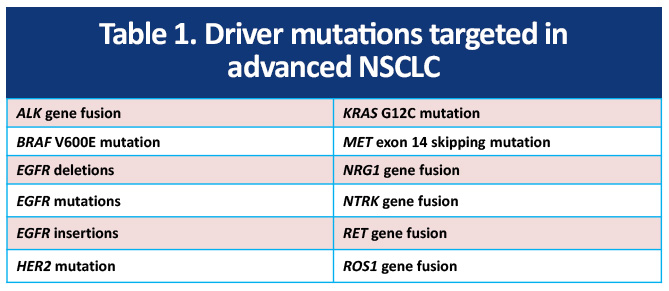
In lung cancer, changes targeted by this class of drug are sometimes called driver mutations (Table 1). Driver mutations help the cancer grow. Drugs targeted to these changes slow or stop the cancer. Your doctor may use a targeted therapy alone or with other drugs. Most of their use is for advanced lung cancer.
Targeted Driver Mutations in Advanced NSCLC
It is important to note that immunotherapy (immune checkpoint inhibitors) may not be the best option for patients with one of these driver mutations. Immune checkpoint inhibitors have less benefit in NSCLC with an EGFR exon 19 deletion or L858R mutation or with ALK, RET, or ROS1 gene fusions.
Types of targeted drugs
Anti-VEGF (also called antiangiogenic or anti-angiogenesis drugs)
Anti-VEGF drugs block blood vessel growth to the tumor. Two anti-VEGF drugs used in lung cancer are:
- Bevacizumab (Avastin®)
- Ramucirumab (Cyramza®)
Anti-KRAS
About 1 in 8 people (13%) with NSCLC have a specific change in the KRAS gene called a KRAS G12C mutation. There are two anti-KRAS drugs that target this mutation.
- Adagrasib (Krazati®)
- Sotorasib (Lumakras®)
Anti-EGFR drugs
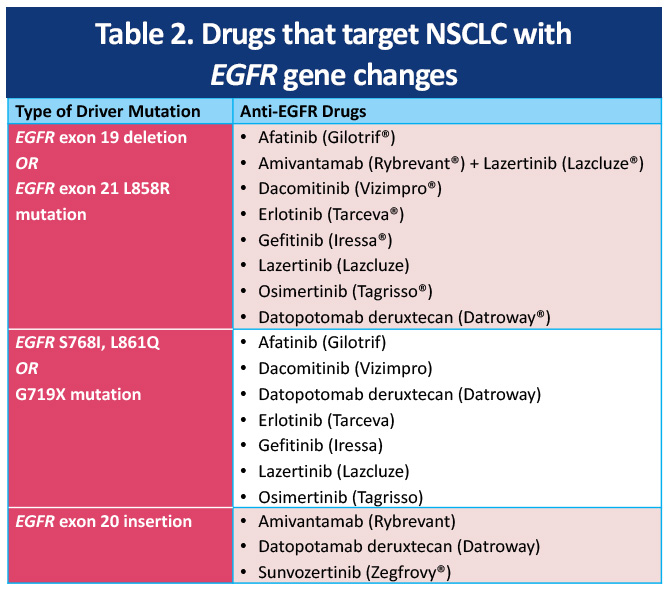
Several types of anti-EGFR drugs are used to treat NSCLC (Table 2). The targeted therapy used is based on the type of EGFR mutation in your cancer, and other things. Most anti-EGFR drugs are small molecules or therapeutic antibodies. On June 23, 2025, the FDA approved datopotamab deruxtecan (Datroway(R)) for previously treated, advanced NSCLC with an EGFR mutation. Datopotamab deruxtecan is a type of drug called an antibody-drug conjugate (ADC).
Anti-EGFR drugs may be used alone or in combination with other drugs (for example, chemotherapy or other targeted therapy). Your doctor will talk to you about the options that are right for you.
Drugs that target cells with ALK gene changes
About 5% of NSCLCs have changes in a gene called ALK. There are five anti-ALK drugs used to treat patients with advanced lung cancer that has an ALK alteration.
- Alectinib (Alecensa®)
- Brigatinib (Alunbrig®)
- Ceritinib (Zykadia ®)
- Crizotinib (Xalkori®)
- Ensartinib (EnsacoveTM)
- Lorlatinib (Lorbrena® )
Drugs that target cells with ROS1 gene changes
About 1% to 2% of NSCLCs have a rearrangement in a gene called ROS1. Five oral drugs used to treat patients with advanced NSCLC that has a ROS1 alteration are:
- Crizotinib (Xalkori®)
- Entrectinib (Rozlytrek®)
- Lorlatinib (Lorbrena®)
- Repotrectinib (Augtyro®)
- Taletrectinib (Ibtrozi TM)
Drugs that target cells with BRAF gene changes
Some NSCLCs have a specific change in a gene called BRAF (BRAF V600E mutation). Oral drugs used to treat NSCLC with this change are:
- Binimetinib (Mektovi®)
- Dabrafenib (Tafinlar®)
- Encorafenib (Braftovi®)
- Trametinib (Mekinist®)
- Vemurafenib (Zelboraf®)
Sometimes two of these drugs are used together, for example, dabrafenib with trametinib or encorafenib with binimetinib.
Drugs that target cells with RET gene changes
A small percentage of NSCLCs have changes in the RET gene. Oral drugs used most often to target advanced NSCLC with certain RET alterations are:
- Cabozantinib (Cabometyx®)
- Pralsetinib (Gavreto®)
- Selpercatinib (Retevmo®)
Drugs that target cells with MET gene changes
Some NSCLCs have a change in the MET gene called a MET exon 14 skipping mutation. Anti-MET drugs used to treat this type of change are:
- Capmatinib (Tabrecta® )
- Crizotinib (Xalkori®)
- Tepotinib (Tepmetko®)
On May 14, 2025, the US FDA approved elisotuzumab vedotin-tllv (Emrelis™) to treat certain types of locally advanced or metastatic NSCLC with high c-MET overexpression.
Drugs that target cells with HER2 gene changes
Some NSCLCs have a change in the HER2 gene that helps them grow.
Drugs used to treat NSCLC with certain changes in HER2 are:
- Sevabertinib (Hyrnuo®)
- Trastuzumab deruxtecan (Enhertu®)
- Trastuzumab emtansine (Kadcyla®)
- Zongertinib (Hernexeos®)
Drugs that target cells with NTRK gene changes
A very small number of NSCLCs have changes in the NTRK gene. Three drugs used to treat advanced NSCLC with certain NTRK gene changes are:
- Entrectinib (Rozlytrek®)
- Larotrectinib (Vitrakvi®)
- Repotrectinib (Augtyro)
References
National Comprehensive Cancer Network (NCCN)®.
NCCN Clinical Practice Guidelines. Non-Small Cell Lung Cancer. Version 5.2026. March 13, 2026. https://www.nccn.org/professionals/physician_gls/pdf/nscl.pdf
National Comprehensive Cancer Network®.
NCCN Guidelines for Patients®. Metastatic Non-Small Cell Lung Cancer. 2026. https://www.nccn.org/patients/guidelines/content/PDF/lung-metastatic-patient.pdf
All URLs accessed April 6, 2026