Introduction

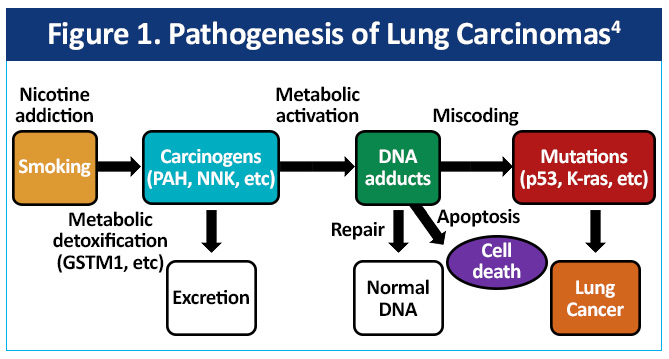
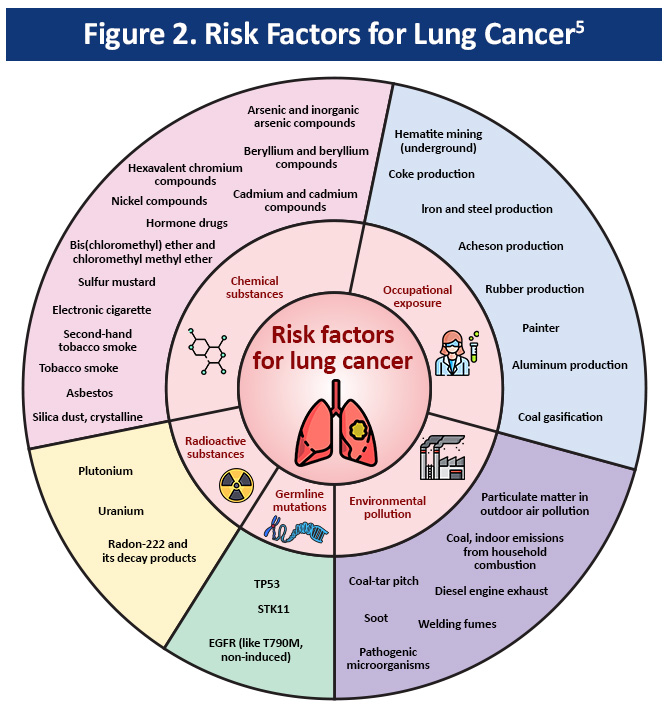
Lung cancer is the leading cause of cancer-related deaths in the United States and worldwide.1,2 Approximately 85% of lung cancers are non-small cell lung cancer (NSCLC).3 Smoking is responsible for 85% to 90% of NSCLC cases.2 There is a dose-effect relationship between the number of cigarettes smoked and lung cancer risk, as well as exposure to tar or tobacco smoke and lung cancer.4 The carcinogenic effects of tobacco smoking are suggested to be due to the accumulation of molecular damage during exposure. Subsequently, a cascade of events leads to the induction of enzymes and the formation of covalent DNA adducts, which may result in DNA misreplication and mutation, and ultimately cancer development (Figure 1). It is important to note that there are numerous risk factors for lung cancer in addition to tobacco smoke (Figure 2).5

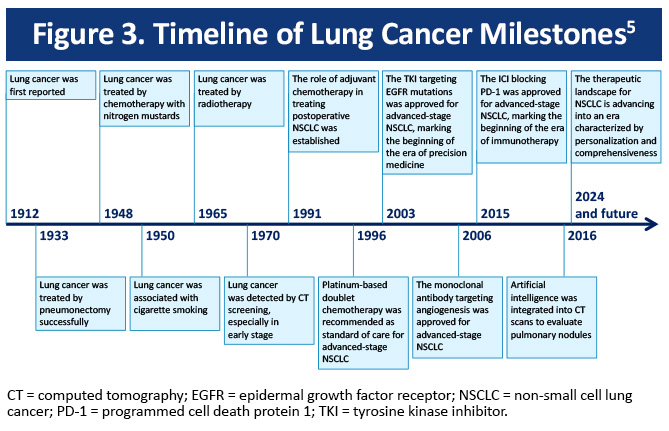
Over the past twenty years, tremendous advances in understanding and management of NSCLC have been made (Figure 3).5 Due to a decrease in the number of people smoking, the number of new lung cancer cases has been decreasing.6 With fewer smokers and numerous developments in early detection and treatment, lung cancer deaths are also decreasing.6,7

The sequence of pathologic and molecular changes involved in the pathogenesis of lung cancer includes molecular changes, such as chromosomal deletions, genetic instability, activation of inflammation-related molecules, cell proliferation, oncogene mutations (eg, KRAS, EGFR, ALK, ROS1, HER2, MET, NTRK, RET), and inactivation of tumor-related genes (eg, TP53, KEAP1, STK11, NF1). The molecular drivers of adenocarcinoma are distinct from those of squamous cell carcinomas. Drivers for squamous cell carcinomas are yet to be fully identified, but common chromosomal aberrations include squamous cell differentiation pathway upregulation (NOTCH, SOX2, and TP63), cell cycle regulation loss (TP53, RB1, CDKN2A, MYC, and SMARCB1), oncogenic signal upregulation (via RAS and PI3K pathways), and epigenetic dysregulation (via KMT2D, NSD1, and KDM6A).5 A complex web of molecular interactions and cellular processes allows for cancer cell survival, subclonal evolution, and drug resistance, ultimately enabling NSCLC metastasis.5

References

  1. American Cancer Society. Cancer Facts & Figures 2026. https://www.cancer.org/content/dam/cancer-org/research/cancer-facts-and-statistics/annual-cancer-facts-and-figures/2026/2026-cancer-facts-and-figures.pdf
  2. World Health Organization. Lung Cancer. June 26, 2023. https://www.who.int/news-room/fact-sheets/detail/lung-cancer
  3. National Cancer Institute. Cancer Trends progress Report. Lung Cancer Treatment. Last Reviewed April 2025. https://progressreport.cancer.gov/treatment/lung_cancer
  4. U.S. Department of Health and Human Services. How Tobacco Smoke Causes Disease: The Biology and Behavioral Basis for Smoking-Attributable Disease: A Report of the Surgeon General. Centers for Disease Control and Prevention; 2010. https://www.ncbi.nlm.nih.gov/books/NBK53017/pdf/Bookshelf_NBK53017.pdf
  5. Huang Q, Li Y, Huang Y, et al. Advances in molecular pathology and therapy of non-small cell lung cancer. Sig Transduct Target Ther. 2025;10:186. https://doi.org/10.1038/s41392-025-02243-6
  6. American Cancer Society. Key statistics for lung cancer. Last revised January 13, 2026. https://www.cancer.org/cancer/types/lung-cancer/about/key-statistics.html
  7. Islami F, Nargis N, Liu Q, et al. Averted lung cancer deaths due to reductions in cigarette smoking in the United States, 1970–2022. CA Cancer J Clin. 2025;75:216-225. https://doi.org/10.3322/caac.70005

All URLs accessed April 14, 2026.

Scientific Council

Neil M. Bressler, MD

James P. Gills Professor of Ophthalmology
Professor of Ophthalmology, Johns Hopkins University School of Medicine
Wilmer Eye Institute, Johns Hopkins Medicine
Baltimore, MD

A. Paul Chous, MA, OD, FAAO

Specializing in Diabetes Eye Care & Education, Chous Eye Care Associates
Adjunct Professor of Optometry, Western University of Health Sciences
AOA Representative, National Diabetes Education Program
Tacoma, WA

Steven Ferrucci, OD, FAAO

Chief of Optometry, Sepulveda VA Medical Center
Professor, Southern California College of Optometry at Marshall B. Ketchum University
Sepulveda, CA

Julia A. Haller, MD

Ophthalmologist-in-Chief
Wills Eye Hospital
Philadelphia, PA

Allen C. Ho, MD, FACS

Director, Retina Research
Wills Eye Hospital
Professor and Chair of the Department of Ophthalmology
Thomas Jefferson University Hospitals
Philadelphia, PA

Charles C. Wykoff, MD, PhD

Director of Research, Retina Consultants of Houston
Associate Professor of Clinical Ophthalmology
Blanton Eye Institute & Houston Methodist Hospital
Houston, TX
Search

[divi_global_search_form]

Clinician Scientific & Educational Resources

The RELIEF Clinical Toolkit is an online tool that aims to provide clinicians with up-to-date information on the presentation, prognosis, pathophysiology, and treatment strategies for retinopathy of prematurity (ROP). Click on one of the options below to learn more about ROP.

Patient Toolkit

Patient Toolkit

Read more

What exactly is NSCLC?

What exactly is NSCLC?

Read more

What symptoms can NSCLC cause?

What symptoms can NSCLC cause?

Read more

How is NSCLC treated according to staging?

How is NSCLC treated according to staging?

Read more

How is early NSCLC treated with surgery or SBRT?

How is early NSCLC treated with surgery or SBRT?

Read more

When is chemotherapy used in NSCLC?

When is chemotherapy used in NSCLC?

Read more

When is radiation used in NSCLC?

When is radiation used in NSCLC?

Read more

When is immunotherapy used in NSCLC?

When is immunotherapy used in NSCLC?

Read more

When is targeted therapy used in NSCLC?

When is targeted therapy used in NSCLC?

Read more

Patient Journey

Patient Journey

Read more

Online resources

Online resources

Read more
This activity is provided by Med Learning Group. This activity is co-provided by Ultimate Medical Academy/Complete Conference Management (CCM). This activity is supported by an independent medical education grant from Regeneron Pharmaceuticals, Inc.

Copyright © 2019 | ROP Relief | All Rights Reserved | Website by Divigner